Why it matters: A Fortune 500 company today produces more hours of live video per year than many regional television stations—yet most run that content through conferencing systems never designed for it. Broadcast AV closes the gap between what organizations are expected to deliver and what their infrastructure can actually support.
What Broadcast AV actually means
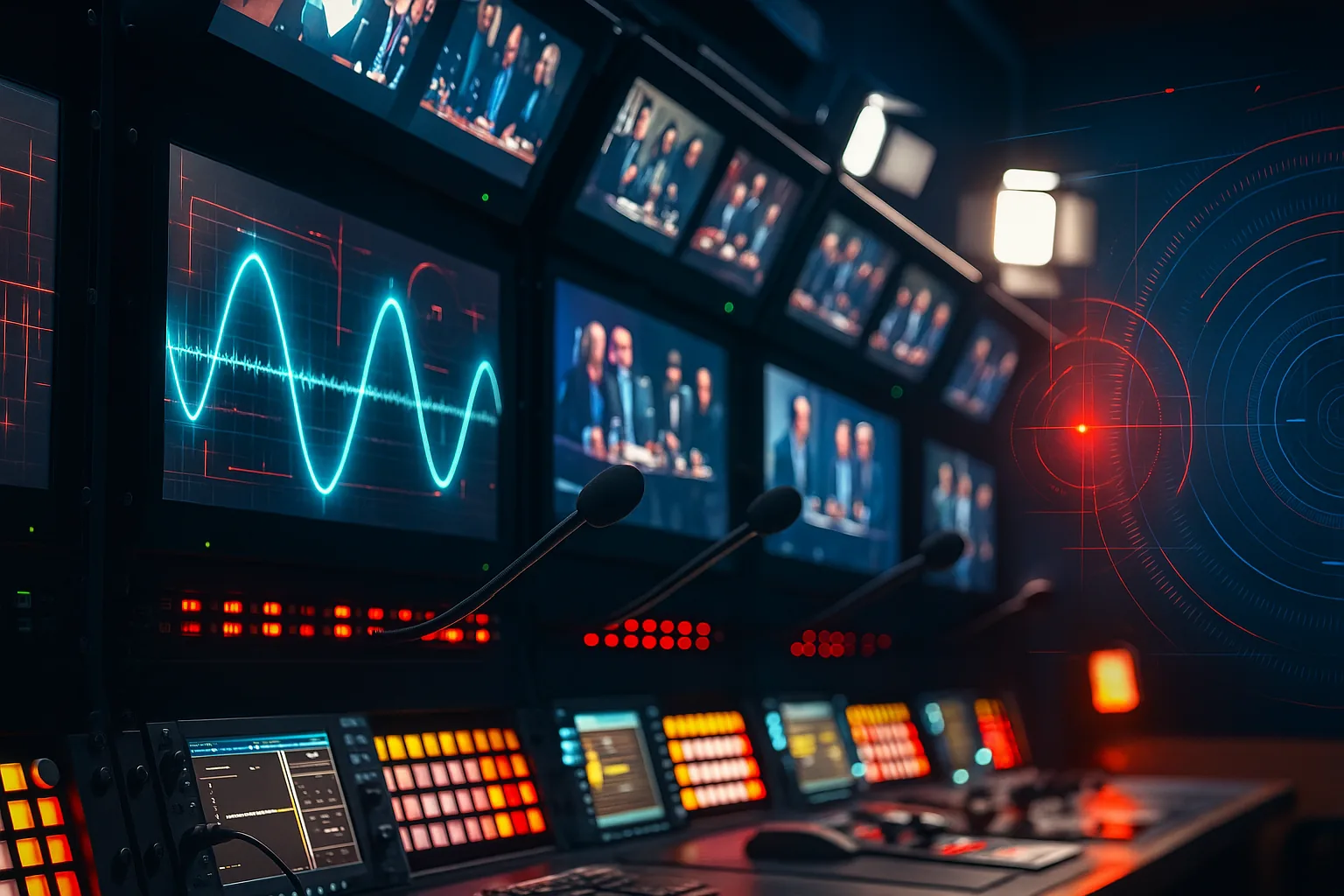
Broadcast AV is not about turning offices into TV studios. It means applying broadcast-quality equipment, workflows, and standards—cameras, switching, graphics, audio, routing, recording, and distribution—within a unified architecture tuned to non-media environments. Operators work inside consistent interfaces regardless of production complexity, so the system scales without requiring a rebuild every time an event grows.
Who is driving demand
- Corporate: All-hands meetings, investor days, and product launches where production quality directly reflects brand credibility.
- Government: Press briefings and public hearings that reach audiences expecting broadcast-standard delivery.
- Education: University graduation livestreams and campus events serving distributed alumni and family audiences.
- Esports: Organizations competing in production values against traditional sports broadcasters for viewer attention.
The gap most organisations are stuck in
Without Broadcast AV infrastructure, organisations face two bad options: hire external production crews for every event—expensive and non-repeatable—or push existing conferencing systems past their design limits using workarounds, manual processes, and individual expertise. Neither scales. Both introduce risk at the moments that matter most.
The market signal
AVIXA now ranks Broadcast AV as the second-largest ProAV solution area globally, growing faster than most traditional AV categories. InfoComm 2026 added a dedicated Broadcast AV zone—a clear signal the market has moved past "emerging" into mainstream deployment.
Primeasure POV
- Evaluate your highest-stakes live events first—investor days, product launches, leadership summits—and work backward to define the minimum broadcast infrastructure needed to deliver them reliably without external crews.
- Prioritise unified architectures over point solutions; stitching together separate cameras, switchers, and streaming tools with manual processes is how conferencing systems get stretched past their limits.
- Plan for operator consistency, not just hardware specs—Broadcast AV's real advantage is that the same interface handles a 50-person all-hands and a 50,000-person livestream without a different toolchain for each.
Ready to Move Beyond Conference-Room Workarounds?
Primeasure can help assess your live video requirements, map the right Broadcast AV architecture, and plan a deployment that scales with your organisation.
Explore Primeasure's Broadcast solutions available across India.
Talk to PrimeasureSource: Grass Valley — When Every Organisation Becomes a Broadcaster: The Rise of Broadcast AV