Why This Matters for Lab Teams
Introspect Technology recently revisited one of the most common questions their applications engineers receive: “Can the RSH2 Remote Sampling Head plug into any oscilloscope?” Their answer is an enthusiastic yes—the RSH2 mates with any 50 Ω instrument—making it a clever way to extend the reach of your existing scopes without adding boutique probe heads for every vendor.
For Primeasure customers running Teledyne LeCroy, Keysight, Rohde & Schwarz, or Tektronix platforms side by side, this compatibility story is powerful. A single remote head can live near the device under test while long, lossy probe leads disappear. Introspect’s write-up inspired us to capture the key takeaways along with a few extra notes from the field.
What Makes the RSH2 Different
- Twelve active probes in one chassis: The RSH2 brings enough channels to fan across parallel buses such as MIPI CSI-2 or D-PHY while keeping the bench uncluttered.
- Minimal loading on the DUT: Each probe is buffered, so sensitive, low-voltage lanes are preserved even when the scope input is a 50 Ω termination.
- Universal 50 Ω output: A standard coax or SMPM cable does the final hop into whatever oscilloscope is free—no adapter forests or vendor lock-in.
- Compact remote head: Sitting the head on the DUT keeps high-speed runs short and controlled, while the heavier oscilloscope remains on the cart.
Recreating Introspect’s Smartphone Camera Demo
Introspect demonstrated the RSH2 by probing a live smartphone camera link. Probe tips were soldered directly onto the application processor and camera interface, then routed through an SMPM adapter into the remote head. From there, a 50 Ω cable carried each lane to the oscilloscope.
The screenshots they shared highlight:
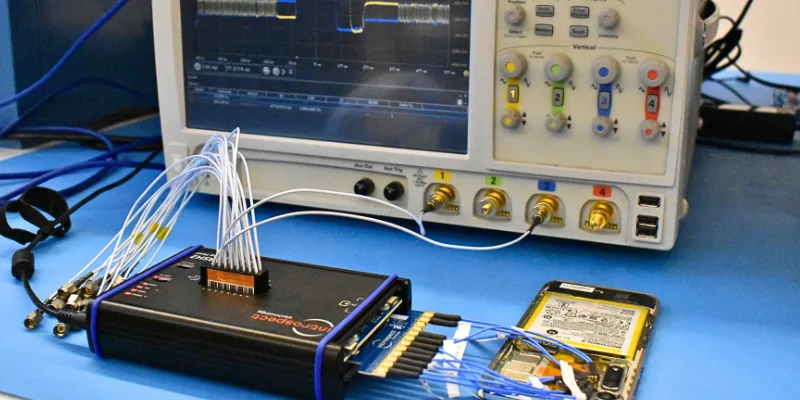
- Figure 1: A tidy bench setup with the handset on a fixture, the RSH2 close to the target, and only coax cables looping back to the oscilloscope.
- Figure 2: A clean D-PHY eye diagram captured in real time, demonstrating that the active probes preserve rise-time fidelity.
- Figure 3: An oscilloscope overlay of the data lanes showing minimal crosstalk even with two channels instrumented simultaneously.
While we can’t redistribute their imagery here, the original article is worth a read for visuals and additional commentary. The workflow echoes what our automotive and handset customers are doing day to day.
Checklist for Your Own Lab
- Plan probe points early: Layout pads or flying leads that will accept the RSH2’s solder-in tips without crowding adjacent components.
- Use quality coax: Keep the run between the RSH2 and the oscilloscope short and rated to the bandwidth you expect to measure.
- Terminate correctly: Leave the scope in 50 Ω mode to maintain signal integrity; the RSH2 is already conditioned for that impedance.
- Correlate with protocol tools: Pair the scope view with protocol decodes or traffic captures so you can tie waveform shape to packet context.
- Document fixture settings: Capture probe placement, cable lengths, and any deskew operations so the setup is repeatable across shifts.
Source Inspiration
This article was informed by Introspect Technology’s post, “Can I Use the RSH2 with an Oscilloscope?”. We recommend reviewing their original piece for the latest product imagery and specifications.
Need Help Integrating Remote Sampling in Your Lab?
Primeasure supports Introspect Technology solutions across India. We can assist with probe planning, oscilloscope selection, and automated analysis workflows tailored to your validation program.
Explore Primeasure's Teledyne LeCroy oscilloscopes available across India.
Talk to Our Test Team