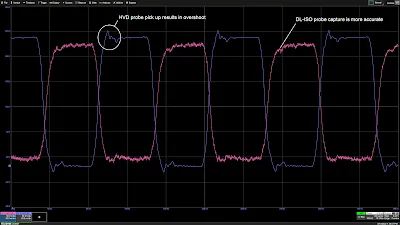
Why it matters: A high-voltage probe that’s under-rated, noisy, or too capacitive can distort waveforms or destroy a scope. Teledyne LeCroy’s framework keeps measurements safe and accurate for power electronics, EV inverters, motor drives, and grid gear.
1) Match voltage rating and derating
Pick a probe whose DC and peak ratings exceed the highest expected waveform with margin. Watch the fine print: some ratings are only at 50/60 Hz. Use generous headroom for fast edges on SiC/GaN switching.
2) Choose attenuation for dynamic range
Higher attenuation (e.g., 100:1) protects the scope and widens input range but reduces sensitivity. Select the lowest ratio that keeps peaks within the probe’s linear region and the scope’s full scale.
3) Mind bandwidth and rise time
Bandwidth must cover the fastest edge rates you need to see. As a rule of thumb, probe bandwidth ≥ 5× the signal’s highest significant harmonic; otherwise overshoot and dv/dt will be misread.
4) Control capacitive loading
High-voltage probes add capacitance that can reshape switching transitions. Compare input capacitance specs and use the shortest ground return possible to reduce ringing.
5) Verify common-mode limits
For floating or half-bridge nodes, check common-mode voltage ratings and isolation category. Differential HV probes help reject common-mode noise and keep both inputs within safe limits.
Primeasure POV
- For SiC/GaN measurements, prioritize probes with low capacitance and ample bandwidth; pair with scopes that support deskew to align voltage/current waveforms.
- Standardize test benches with documented derating rules and probe-to-scope attenuation presets to avoid misconfiguration.
- Add a quick pre-test checklist (ratings, attenuation, bandwidth, CMV) to every power lab station.
Need HV probing guidance?
Primeasure can help choose probes, set derating rules, and deskew voltage/current pairs for power labs.
Explore Primeasure's probes and accessories available across India.
Talk to PrimeasureSource: Teledyne LeCroy — Choosing the Best High Voltage Oscilloscope Probe